
The average doctor salary in the U.S. ranges from about $300,000 to over $600,000 depending on the specialty. Earning a high salary does not always lead to long-term wealth or financial freedom.
Some doctors turn high income into a strong net worth. Many do not. The difference isn’t intelligence, effort, or specialty prestige. It’s how salary interacts with debt, taxes, lifestyle, and time.
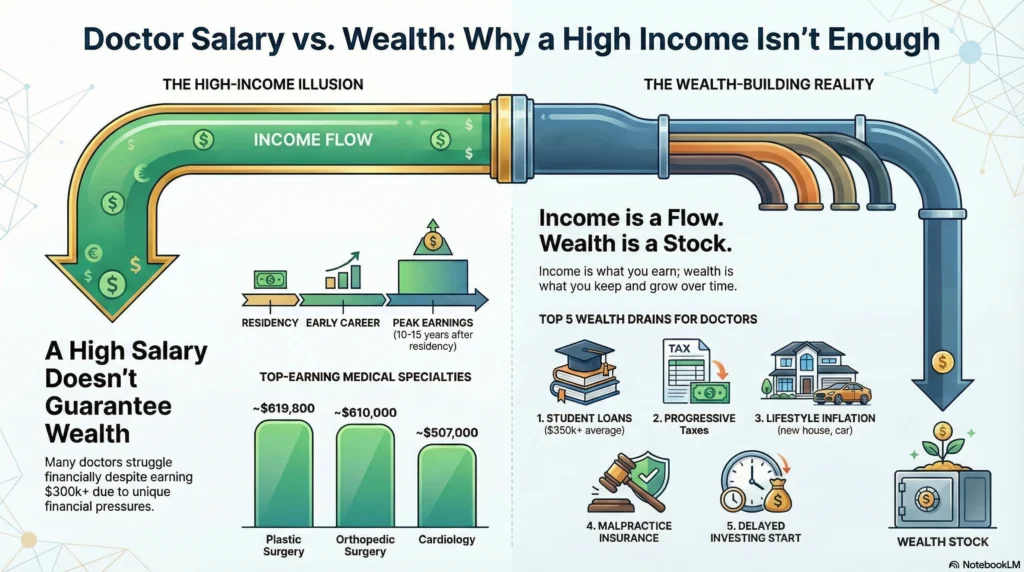
According to recent reports, the average family medicine doctor earns about $300,800 per year, while a plastic surgeon averages around $619,800 annually. Mid-tier specialties such as psychiatry, cardiology, emergency medicine, and radiology usually make between $300,000 and $500,000 in medical income. On paper, those numbers look like a guaranteed path to wealth.
But income is only one variable. And for many physicians, it’s the most misleading one.
What “Average Doctor Salary” Really Means
When you see headlines about the average doctor salary, it’s easy to assume that number reflects what most doctors actually take home. It doesn’t.
“Average” usually means mean income, not median. Physician pay is affected by extreme cases. High-earning surgeons, private practice owners, and doctors with extra income from places like botox clinics, imaging centers, or dental surgery partnerships earn much more.
In practical terms:
- A handful of orthopedic surgeons or plastic surgeons earning $1M+ can pull the average up.
- Meanwhile, large groups of internists, pediatricians, and family practice physicians earn far less.
- Gender pay gap and racial disparities also distort averages, with women and minority physicians often earning less even within the same specialty.
That’s why salary transparency matters. Without it, doctors compare themselves to inflated benchmarks instead of realistic peer data.
Key Factors That Influence Doctor Salaries
Doctor pay is shaped less by talent and more by structure. Two physicians with identical training can earn wildly different incomes based on where and how they practice.
Location, Practice Setting, and Demand
Geography plays a major role in physician compensation.
Rural areas and underserved regions often pay more due to supply shortages. Urban academic centers, while prestigious, frequently pay less due to saturated labor markets and teaching obligations.
Demand also matters. Procedural reimbursement helps radiology, anesthesiology, and surgery. Hospitals also rely on these specialties. Primary care and internal medicine depend more on volume and payer mix.
This imbalance creates systemic inequity in compensation across specialties—even though patient experience and workload may be comparable.
Employment Type: Hospital, Private Practice, or Self-Employed
How you’re paid matters as much as how much you’re paid.
- W-2 hospital employees trade stability for limited upside.
- Private practice owners absorb risk but gain income potential.
- Locum tenens physicians often earn higher hourly rates but lack benefits.
- Self-employed doctors must cover malpractice insurance, retirement planning, and support staff costs.
Some physicians even operate through LLCs, allowing income smoothing and expense management—but also adding complexity.
Just like a website needs verification, captcha checks, Ray ID tracking, and Client IP monitoring to protect value, doctors need structural safeguards to protect income from erosion.
Average Doctor Salary by Specialty
This is the core question most physicians search for, and for good reason.
Highest-Paid Medical Specialties
Based on the most recent Doximity Physician Compensation Report, the highest earners include:
- Plastic Surgery: ~$619,800
- Orthopedic Surgery: ~$610,000
- Cardiology: ~$507,000
- Radiology: ~$498,000
- Anesthesiology: ~$472,000
These specialties benefit from procedure-based billing, operating room leverage, and higher reimbursement per unit of work.
But they also come with:
- Longer residency and fellowship paths
- Higher malpractice coverage costs
- More physical and cognitive stress
- Greater burnout risk
Lowest-Paid but High-Demand Specialties
Lower-paid does not mean low value.
Family practice, pediatrics/adolescent medicine, psychiatry, and internal medicine form the backbone of the healthcare system.
Typical salaries include:
- Family Medicine: ~$300,800
- Pediatrics: ~$275,000
- Psychiatry: ~$323,000
These fields offer better continuity of care and often better sleep schedules—but less income potential unless paired with smart financial planning.
Starting Salaries vs Peak Earning Years
One of the biggest mistakes doctors make is anchoring on starting salary.
After medical school and residency, early-career physicians often feel “rich” for the first time. But these years are deceptive.
Peak earning years usually arrive 10–15 years post-residency, once:
- Student loans are reduced
- Negotiation skills improve
- Practice ownership or partnership emerges
- Administrative roles or side income develop
This lag is why comparing yourself to peers in tech or finance can feel discouraging early on.
For a deeper breakdown, read:
Read: [Net Worth by Age for Doctors in Training vs Attending Physicians]
Why High Salary Does Not Equal Wealth
Income is a flow. Wealth is a stock.
Doctors are trained to focus on salary, not net worth. That’s the trap.
A physician earning $450,000 with:
- $350,000 in student loans
- A $1.5M mortgage
- Lifestyle inflation
- Poor investing habits
may build less wealth than someone earning half as much.
This disconnect is why so many physicians feel financially stressed despite high income.
Read: [Doctor Net Worth vs Financial Freedom: Why They’re Not the Same Thing]
The Hidden Costs That Reduce Take-Home Pay
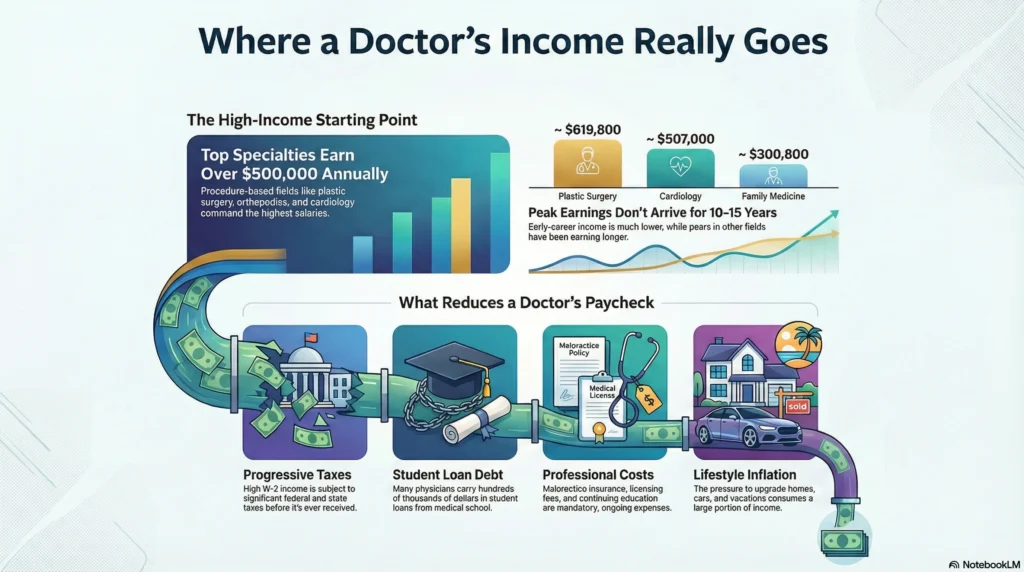
Several invisible forces quietly erode doctor income:
- Progressive taxes on W-2 income
- State tax differences
- Student loans and medical loans
- Malpractice insurance premiums
- Continuing education requirements
- Opportunity cost of long training paths
- Lifestyle inflation (“I finally made it” spending)
These costs don’t show up in headline salary numbers—but they dominate real financial outcomes.
Salary vs Net Worth: The Gap Most Doctors Don’t See
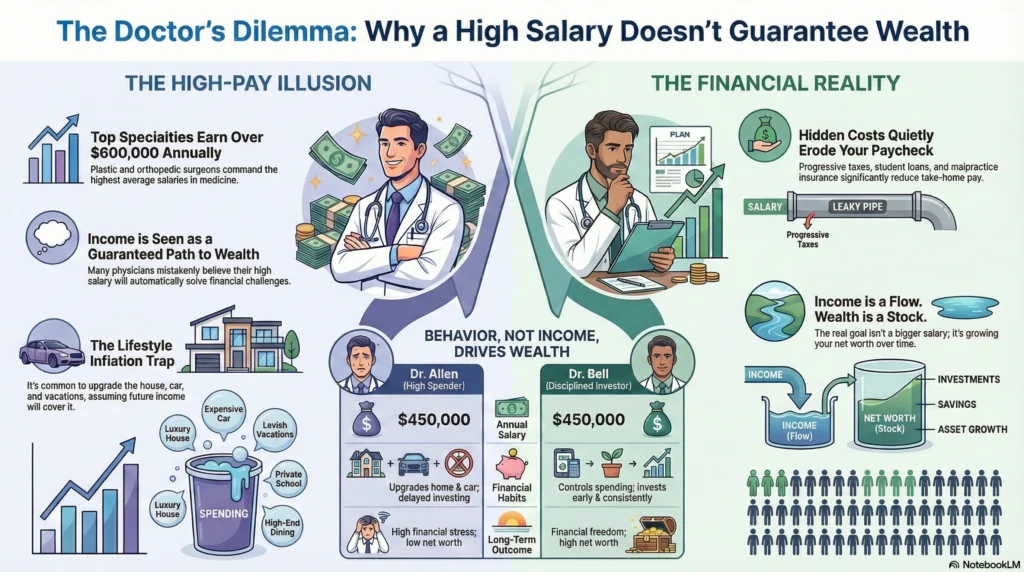
Two doctors. Same salary. Very different futures.
One tracks spending in an Excel spreadsheet, invests early, and resists lifestyle creep.
The other upgrades everything at once—house, car, vacations—assuming income will fix it later.
Over time, compound interest rewards the first and punishes the second.
This gap explains why some physicians reach financial independence early while others feel trapped.
What Doctors Should Look At Beyond Salary
If salary isn’t the goal, what is?
Doctors should focus on:
- Net worth growth
- Cash flow stability
- Optionality (ability to cut hours or change roles)
- Control over time and sleep
- Long-term resilience
That’s why many physicians eventually ask deeper questions about purpose, burnout, and sustainability.
Read:
What to Do Next (Without Pressure)
If this guide felt helpful but overwhelming, that’s okay.
You do not need to master everything at once.
Here are simple next steps.
 Listen to the audio version of this guide while commuting or between shifts
 Read our book on Amazon for a structured walkthrough of financial freedom for doctors
 Download the free LIFTOFFNOW ebook to understand the full framework
 Book a free 10–15 minute clarity call if you want to talk through your situation
Medicine and Money Show exists to educate, not sell.
No courses.
No coaching.
No financial products.
Just clear guidance for doctors who want to turn hard work into lasting wealth.
FAQ
Most U.S. doctors earn between $120 and $300 per hour, depending on specialty, location, and practice setting. Procedural specialists and locum tenens physicians often earn more, while primary care doctors earn less on an hourly basis.
Most doctors earn $20,000 to $50,000 per month before taxes, depending on specialty and employment structure. This does not account for taxes, student loans, malpractice insurance, or practice expenses.
New attending physicians usually earn 30–40% less than peak-career averages. Primary care starts around $200K–$240K. Many procedural specialties start between $300K–$400K.
Yes, locum tenens doctors often earn higher hourly rates, but trade off benefits, stability, and long-term career leverage. Higher pay compensates for flexibility, travel, and lack of employer-sponsored benefits.
Specialties like orthopedic surgery, plastic surgery, cardiology, anesthesiology, and radiology often earn more than $500,000 each year. This is especially true in private practice or areas with high demand.
Doctor salaries vary widely. Primary care doctors make between $250,000 and $325,000. Surgical subspecialists make over $600,000. Salary differences depend on specialty, location, and practice ownership.
Primary care doctors, pediatricians, and some academic internal medicine doctors usually earn the lowest salaries. This is often because of how reimbursements work, not because of their workload or complexity.
Only about 5 to 7 percent of doctors earn more than $1 million each year. These doctors usually own practices, have multiple income sources, or work in highly specialized procedural fields.
High salaries don’t guarantee wealth because taxes, student loans, lifestyle inflation, and late earning starts often consume income faster than assets are built.
Student loans, taxes, housing upgrades, malpractice insurance, childcare, and delayed investing are the biggest expenses that quietly erode doctors’ wealth-building potential.
Doctors build wealth by controlling lifestyle costs, investing early, reducing taxes, and creating assets outside their clinical income. They do not build wealth just by earning a higher salary.
High earners often struggle because income arrives late, spending scales fast, and financial education is minimal during training, leading to delayed or inconsistent investing.